The Child Lost in the Woods
Die, My LoveThe Child Lost in the Woods is the novel's most sustained descent into the narrator's wilderness — a scene in which the boundary between mother and animal, devotion and violence, baptism and drowning collapses entirely. Fleeing the house and its suffocating domestic order, the narrator carries her baby son into a forest that has swollen into a jungle, loses him, finds him climbing trees, and then, in a single terrible gesture, dunks him in icy water and 'baptises him by mistake.' The child turns pale, begins to fade like a painting, and only returns to life at midnight, in the hours after the dog and the wolf have yielded the night to the bats. It is the episode where the novel's governing images — the stag's golden eye, the mocking animals, the electric fence, the shouting neighbours — all converge, and where the narrator's famous declaration, 'My real man isn't human, I know, but who wants to be human?', finds its fullest dramatic embodiment.
Flight into the Jungle
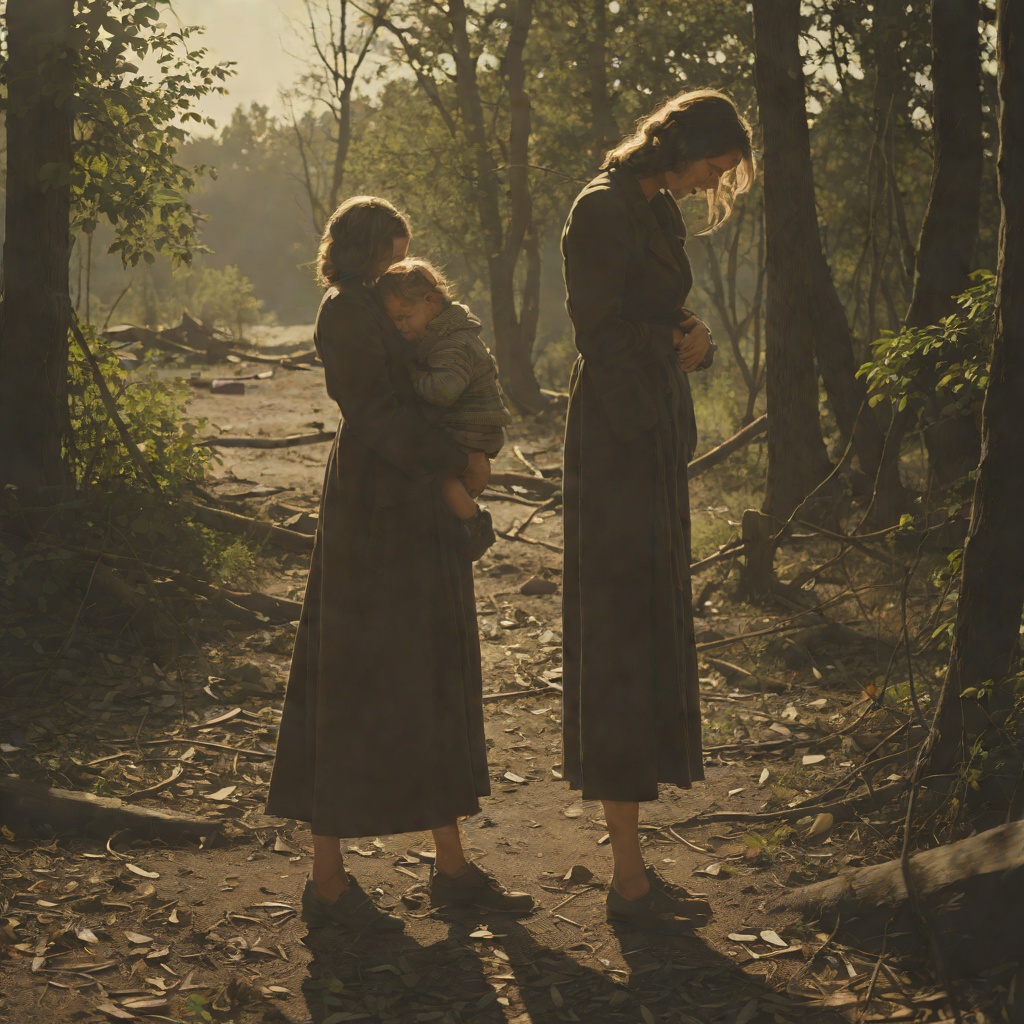
The episode begins not as an escape but as a transformation. The baby is crying with 'false convulsions' while water falls from the sky and the chlorine fails to stop the pool from rusting — the domestic world already corroding. The narrator ties her baby to her body and the two become 'a kangaroo and her joey,' hopping across a field of thorns, bees, and wildflowers. They trample the mounds of earth left by 'subterranean intruders,' and the narrator walks over a huge deposit of hundreds, thousands of worms, jumping on them and squishing them with her baby kangaroo. She hurts her ankles, ducks to pick ticks off her skin, brushes away nettles, bobbing 'in a funny monkey-like way.' The scene is saturated with animality before the woods even arrive: the narrator is already kangaroo, monkey, faun. When they reach the woods, she unties her baby and lets him walk on the downhill slope — and a moment later, she loses sight of him.
The Search and the Finding
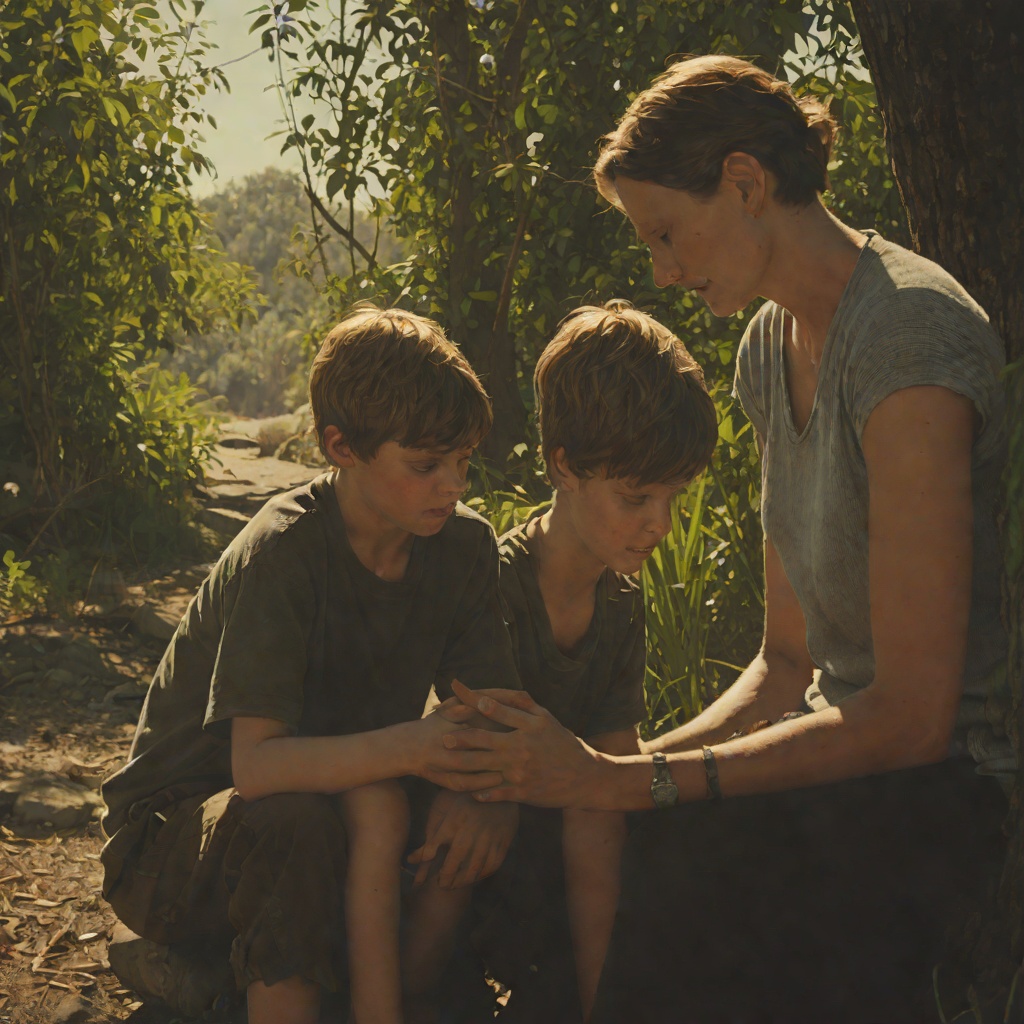
The loss triggers a panic that the narrator refuses to render as ordinary terror. She begins to run, arms flailing, words coming out of her mouth. She hears a gunshot and turns her head 'furtively, ingenuously, like a faun,' pricking up her ears. Her heart beats so fast she expects to find her son covered in mud among the fallen leaves. But then the search changes register entirely: she looks for him 'as only a mother can look for her child' — not by running or walking, not through physical actions at all. She finds him lying on branches higher than even she would have climbed. He motions to her with his hand and says, 'Cu-cu ma-ma.' He had only just started walking, and already he was climbing trees. 'I've given birth to a little savage,' she thinks. She scrambles up and they sit holding on to each other, looking out over the water sweeping across the woods, now more jungle than forest. They see the little rabbit skulls and the death of a tiny chick separated from its nest, its mother's sharp black beak wide open in fear.
The Accidental Baptism
From this vantage, the narrator begins to feed her son the forest itself: swamp water from the pond, petals from the most colourful and fragrant flowers, leaves to chew for their sap. They mimic the calls of the animals around them, becoming part of them. The diurnal and nocturnal birds answer back, and they hear the cry that begins peacefully and turns mournful halfway through — the pleasant vowel 'Aa' changing into the hoarse, fearsome consonant 'Och.' The narrator describes a bird that calls out and becomes two birds: 'sane and insane, tame and murderous.' Then comes the pivotal gesture: she dunks her son in the icy water and baptises him by mistake. 'May God forgive me.' The child seems too pale to be real — not a child but a painting, the sketch of a child, the archetype. He has begun to fade. The narrator compares herself to those beasts that give birth to dead offspring on their way somewhere and spend days kicking at the stillborn creature, attempting to revive it. She shakes her child and wraps him up in her red flesh. He comes to at midnight. The hours of the dog and the wolf are over, and it is the bats' turn to take the night. She pushes at him with her legs, rallying him, but his breathing is still laboured.
The Stag and the Hunters
The road surrounds them, and beyond it the electric fence enclosing the white cows with short horns. They are on hunting ground. Voices are calling their names, but the narrator says they forgot them long ago. The searchers — the neighbours with giant lanterns, and Daddy — are looking for them, but the narrator dismisses their calls as 'blah blah blah or cock a doodle doo.' The animals are mocking them. Then the stag stops in his tracks, embalmed, eyes of glass, so touchingly still. He is 'the man of my life, the one who can see into my infinite sadness.' The others are just men. 'What good are men when they speak a language that falls short?' The narrator's son pulls on the stag's triangular ear and its black snout, but the animal does not laugh. She proposes they camouflage themselves, cover their skin with dirt and greenery. The shouting grows louder. The crowd, she says, is like a stabbing pain — it can only do harm. Half the world is out there, but none of them does them any good.
The Return to the House
The episode closes with a jarring cut back to the domestic sphere. The phone rings; the narrator leaves the baby with his nappy hanging loose and manages to say a few words — 'Hello, mmm, that's right, yes' — but her tone gives her away. She imagines what she could have said instead: 'How's the family?' or 'Did you hear there's a huge storm coming our way?' But there is no getting around the tone of her voice, the way she fixes her gaze on something, rudely narrowing her eyes, her tongue dry or too wet. She hears a shout — 'They're killing my son' — or perhaps they have caught a calf by the neck. Something is going on, an organised slaughter out there. But no, it is in here. Her husband comes towards her and she thinks this time he will finally touch her. She swallows, but nothing goes down. He has taken everything, left her with half a mouth, ragged and full of rasping air. Her better half had been listening in from behind the door — 'yes, the playwright of my life is that mediocre.' He told her to hang up and leave.
The Child Lost in the Woods is thus not merely a scene of maternal panic but the novel's most complete statement of its central opposition: the wild, animal, pre-linguistic bond between mother and child against the 'normal family' that hunts them down with lanterns and phone calls. The accidental baptism — at once a near-drowning, a religious rite, and a rebirth — condenses the narrator's ambivalence toward motherhood itself: she is the beast that kicks at her stillborn offspring, the mother who feeds her child swamp water and flower petals, the woman who finds her true mate in a stag with glass eyes. The episode's hallucinatory intensity, its refusal to distinguish memory from fantasy, devotion from violence, is the novel's signature mode, and here it reaches its peak. The child survives, but the narrator's alienation from the human world is complete: the animals answer her, the stag sees into her infinite sadness, and the men — husband, neighbours, the whole shouting crowd — speak only a language that falls short.